Wax Play Temperature Safety: Low-Melt Soy vs Paraffin & Burn Prevention
Written by Elena Rostova
Certified Intimacy Educator & Materials Specialist
Medically Reviewed
Dr. Sarah Jenkins, MD, FACOG
The Direct Answer (Key Takeaway)
Standard household candles (beeswax and paraffin) melt between 140°F and 160°F (60–71°C), which causes blistering second-degree burns on skin. Specialized sensual wax play candles are formulated with low-melting-point soy wax that melts safely at 115°F to 130°F (46–54°C). Always test melted wax on your inner wrist, pour from a height of at least 12 inches to allow in-air cooling, and keep cold water nearby.
Sensory temperature play — the sudden contrast between cool skin and warm molten drops — triggers an intoxicating release of endorphins and adrenaline. However, using the wrong candle is one of the most common causes of accidental burns in intimacy. Understanding wax chemistry and the physics of pouring distance separates safe sensory bliss from emergency room visits.
Melting point temperature hazard scale
Candle waxes differ fundamentally in chemical composition and melting thresholds. Household decor candles are engineered to burn hot to maximize fragrance throw, making them dangerous on human skin:
| Wax Composition | Melting Point (°F / °C) | Skin Safety Rating | Burn Hazard Profile |
|---|---|---|---|
| Low-Melt Sensual Soy Wax | 115°F – 128°F / 46°C – 53°C | SAFE for sensory play | Pleasant thermal sting; zero blistering or tissue damage |
| Pure Cosmetic Beeswax | 144°F – 149°F / 62°C – 65°C | UNSAFE for direct skin drip | Causes first-degree burns and skin peeling |
| Household Paraffin Pillar | 135°F – 155°F / 57°C – 68°C | HIGH RISK / DANGEROUS | High thermal mass retains heat; causes blistering burns |
| Taper / Birthday Candle Wax | > 160°F / > 71°C | EXTREMELY DANGEROUS | Immediate second-degree burns and scarring |
The physics of pouring height: Cooling in freefall
When molten wax leaves a candle wick, it begins cooling through aerodynamic convection during its downward fall. A single drop of 125°F soy wax cools by roughly 1.5°F for every 3 inches it travels through ambient air:
- Begin at 18 to 24 inches: Starting high allows maximum in-air cooling. The drop hits the skin as a soft, warm splatter that establishes initial tolerance without shocking the nervous system.
- Gradually lower to 10 to 12 inches: Once your partner signals comfort (via verbal check-in or the traffic light system), lowering the candle provides a sharper, more focused thermal sensation.
- Never hold a candle closer than 8 inches: At close range, drops hit the skin before losing ambient heat, substantially raising burn risks.
- Test on your own inner wrist first: Always tip the candle and catch the first 2 drops on your own forearm before pouring onto your partner.
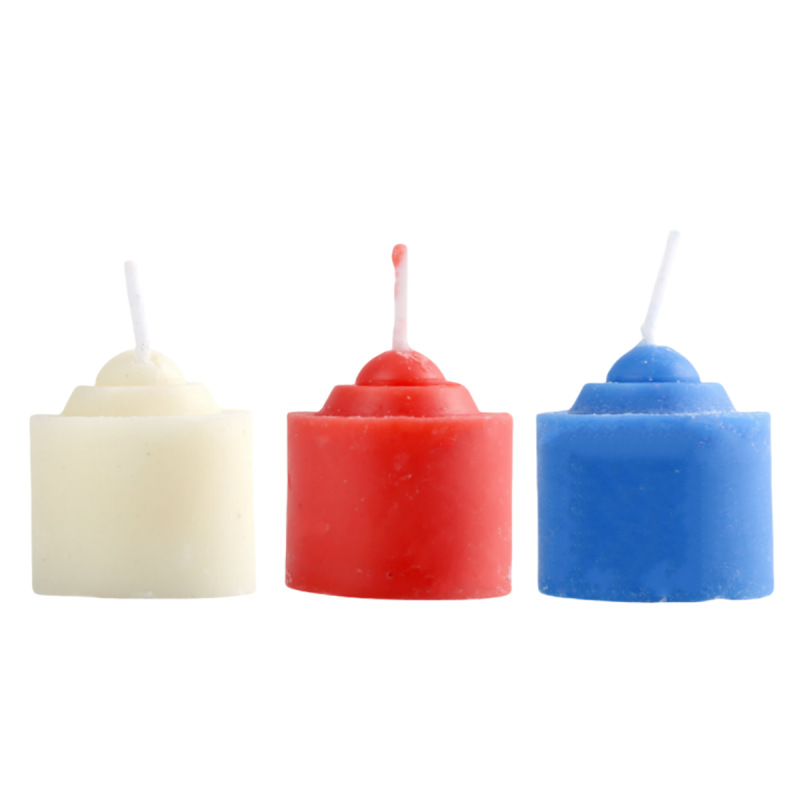
3-Piece Low-Temperature Sensual Drip Candle Set
Non-toxic botanical soy wax candles melting at a skin-safe 120°F (49°C), formulated to peel away cleanly without residue.
Safe anatomical zones vs off-limit danger areas
Skin thickness varies significantly across the human body:
Post-play cleanup and removal
Removing cooled wax should be satisfying, not painful:
- Allow complete cooling (1 to 2 minutes): Let the wax pool solidify fully into a brittle shell before attempting removal.
- Flex the underlying muscle: Asking your partner to flex their shoulder blades or glutes naturally cracks the wax plate away from skin pores.
- Use a flexible silicone or plastic scraper: Never scrape with metal blades or fingernails that scratch the skin.
- Apply cosmetic body oil: Rubbing a small amount of jojoba or mineral oil dissolves botanical wax bonds effortlessly, especially around fine body hair.
Sensory Temperature Essentials
Featured Recommendations
Sensual Floral Low-Temp Candle
Botanical soy blend infused with subtle floral essential oils and skin-nourishing butter.
3-Piece Low-Temp Drip Candle Set
Three vibrant low-melting drip candles engineered for temperature play.
The bottom line
Wax play is a mesmerizing sensory art form when performed with the right chemistry and height control. Never improvise with dining room candles. Explore our certified low-temperature wax play collection and pair with soft restraints for an unforgettable sensory journey.
Explore Body-Safe Collection
Discreet 100% plain shipping, curated medical-grade essentials.
Published September 14, 2026. Medically reviewed for clinical accuracy by Dr. Sarah Jenkins, MD, FACOG. This content is intended for sexual health education and informational purposes, not clinical medical diagnosis.
More from Care & Safety
Lube Science: Osmolality, pH & Why Glycerin-Free Matters for Safety
Body-safe personal lubricants must match the natural chemistry of human mucosal tissue. A vaginal lubricant should maintain an acidic pH between 3.8 and 4.5 and an iso-osmolar concentration under 380 mOsm/kg. Hyper-osmolar lubricants packed with glycerin or propylene glycol draw water out of epithelial cells, causing tissue dehydration, micro-tears, and an increased risk of bacterial vaginosis (BV) and yeast infections.
Butt Plug Sizing & Safety 101: Flared Bases, Gradual Sizing & Hygiene
The single most critical rule of anal toys is a wide, sturdy flared base or T-bar handle. The rectum exhibits involuntary peristaltic smooth muscle contractions that can draw un-flared objects inside, requiring emergency medical intervention. Beginners should choose a tapered silicone plug with a maximum diameter under 1.0 inch (2.5 cm), use generous water-based lubricant, and progress slowly without forcing.
The Fantasy Dildo Guide: Silicone Durometer, Ovipositors & Safe Care
Fantasy dildos are categorized by firmness using the Shore hardness scale. Shore 00-20 to 00-30 represents ultra-soft, squishy "fleshy" silicone that yields easily to body contours; Shore 00-50 represents balanced medium firmness; and Shore 10A represents rigid silicone designed for firm, targeted pressure. All fantasy silicone toys require 100% water-based lubricant and should be sanitized by boiling for 5 minutes.
Chastity Cage Sizing & Hygiene: How to Measure Ring Diameter & Fit
Measuring for a chastity cage must be done while completely flaccid using a flexible tailor’s tape looped behind the scrotum and around the penile base. Base rings are sized by inner diameter (typically 40mm to 50mm). When between sizes, always size up: an overly tight ring restricts blood circulation and causes edema, while an overly loose ring permits slippage.